
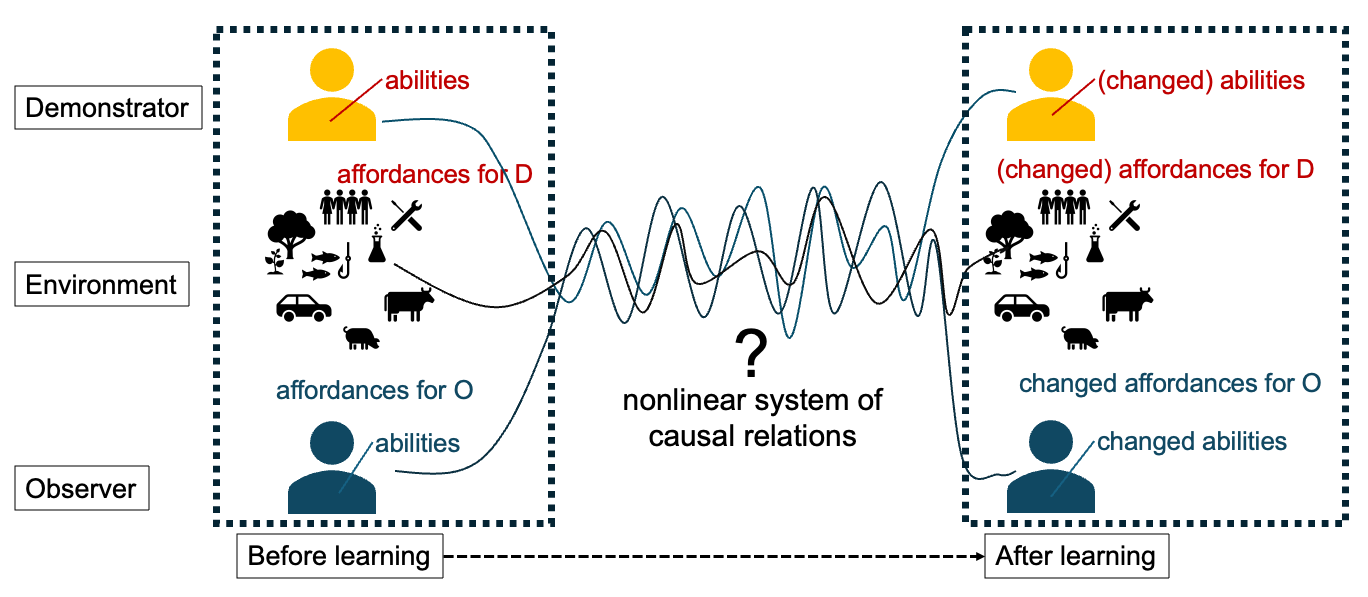
Rethinking social learning as an embodied-embedded process of skill development.
Social learning (put simply, learning from/with others) and related ideas about human and animal ‘cultures’ have attracted enormous scientific interest in the past decades with lab and field studies. Social learning has far-reaching theoretical implications for biology, psychology, and anthropology, as well as ethical and political implications for education and animal conservation. The proposed theories and accumulated evidence have improved our understanding of the evolutionary origins of human cognition, but some important shortcomings remain unresolved. The dominant approach conceives of social learning in terms of the ‘transmission of information’ between individuals. This way of thinking, partly inspired by Shannon’s model of communication systems, implies an active transmitter and a passive receiver of signals. But individuals interacting in a social learning situation often adjust their behaviour relative to what the other is doing and these contingent, moment-to-moment adjustments are not captured by the transmission model. To overcome the limitations of the transmission model, I have been developing an alternative way of thinking about social learning that integrates insights from developmental systems theory, ecological psychology, and relational approaches in anthropology. This project includes my master’s dissertation, my PhD thesis, and is one that I intend to continue in my career.
Associated publications:
- Pagnotta, M., Psujek, M., Straffon, L. M., Fusaroli, R., & Tylén, K. (2025). Drawing Animals in the Paleolithic: The Effect of Perspective and Abbreviation on Animal Recognition and Aesthetic Appreciation. Topics in Cognitive Science, tops.70023. https://doi.org/10.1111/tops.70023
- Pagnotta, M., Laland, K. N., & Coco, M. I. (2020). Attentional coordination in demonstrator-observer dyads facilitates learning and predicts performance in a novel manual task. Cognition, 201, 104314. https://doi.org/10.1016/j.cognition.2020.104314
- Pagnotta, M. (2018). Living and learning together: Integrating developmental systems theory, radical embodied cognitive science, and relational thinking in the study of social learning [Thesis, University of St Andrews]. https://research-repository.st-andrews.ac.uk/handle/10023/16386
- Pagnotta, M. (2014). On the controversy over non-human culture: The reasons for disagreement and possible directions toward consensus. Behavioural Processes, 109, 95–100. https://doi.org/10.1016/j.beproc.2014.04.008
- Resende, B., Nagy-Reis, M., Lacerda, F., Pagnotta, M., & Savalli, C. (2014). Tufted capuchin monkeys (Sapajus sp) learning how to crack nuts: Does variability decline throughout development? Behavioral Processes, 109, 89–94. https://doi.org/10.1016/j.beproc.2014.09.002
- Pagnotta, M., & Resende, B. D. (2013). A controvérsia em torno da atribuição de cultura a animais não humanos: Uma revisão crítica. Estudos de Psicologia (Natal), 18, 569–577. https://doi.org/10.1590/S1413-294X2013000400004